
 EN
Printable Self-Adhesive Film for Indoor and Outdoor Graphics
Choosing self-adhesive film for a printed graphic is not simply a question of gloss versus matte. A wall graphic in a climate-controlled showroom, a short-term exhibition panel, and an outdoor directional sign place very different demands on the face stock, adhesive, print surface, and finishing process. For sign makers, print providers, and distributors, the useful decision is to match the self-adhesive film to the job before production begins.
From a digital-print-media advisor’s perspective, the most reliable approach starts with the installation environment and printer workflow rather than a headline price. It also prevents a common mistake: treating every pressure-sensitive graphic material as interchangeable. The steps below help production teams compare self-adhesive film options without making unsupported assumptions about lifespan or adhesion on an unknown surface.
Start with the graphic’s job, not the material name
The phrase self-adhesive film can refer to materials intended for labels, decorative surfaces, window applications, or printed signs. For graphics work, define the use case in practical terms: indoor or outdoor, flat or curved, temporary or long-term, viewed up close or at distance, and protected by a laminate or left unlaminated. These details affect which self-adhesive film construction is sensible to sample.
Indoor graphics often prioritize print appearance, smooth application, and clean presentation. Retail promotions, posters, display panels, exhibition graphics, frame inserts, wedding backdrops, and memorial displays may have limited exposure to moisture and ultraviolet light. Outdoor graphics must account for changing temperature, sunlight, rain, surface contamination, and mechanical wear. Neither setting automatically determines the right self-adhesive film; the substrate and installation conditions still matter.
Compare the construction in four layers
1. Face stock and print receptivity
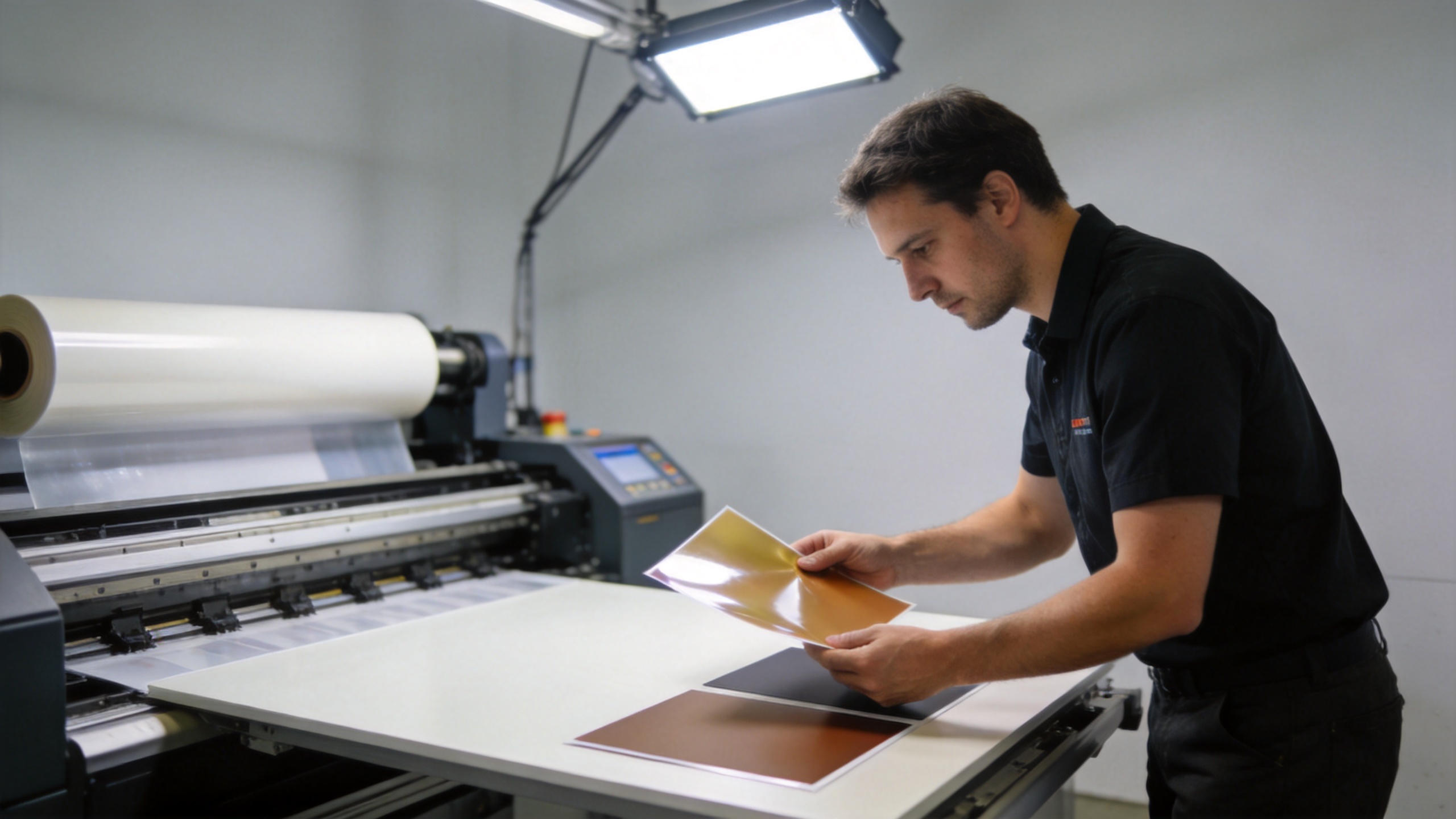
The printable face is where color, dot control, and visual finish are decided. Ask which ink systems a proposed self-adhesive film has been evaluated with, then test it on the actual printer and ink configuration. A sample that looks clean under one workflow can behave differently when ink load, drying, profiling, or production speed changes. If the graphic will be viewed under strong lighting, compare gloss, matte, and texture samples in the intended location rather than judging under office light alone.
2. Adhesive behavior and the target surface
Adhesive selection should follow the substrate, its cleanliness, its texture, and the required removal behavior. Smooth painted panels, glass, low-energy plastics, textured walls, and rough outdoor boards do not offer the same bonding conditions. Good purchasing questions include the recommended application temperature, dwell time before final bond, and removal expectations. Peel adhesion can be compared under controlled conditions; ASTM D3330 is one recognized family of methods for measuring peel adhesion of pressure-sensitive tape. That does not prove performance on every project surface, but it gives buyers a clearer question to ask of a self-adhesive film supplier.
3. Liner, handling, and application window
The liner influences converting, printing, cutting, peeling, and application. A production team should test whether the self-adhesive film feeds consistently, releases cleanly during weeding where relevant, and can be positioned without stretching or trapping air. Application should be assessed on a representative panel, not only on a small bench sample. Record the surface preparation, ambient temperature, applicator method, and any laminate used so later results are comparable.
4. Finishing and protection
For many graphics, the decision is a system decision: printed self-adhesive film plus laminate, ink, cutting settings, and installation practice. A compatible overlaminate may change appearance, cleanability, and resistance to scuffing. Where surface hardness matters, buyers can ask how the finish is evaluated; ISO 15184 describes a pencil method for determining the film hardness of paints and varnishes. It is a useful evaluation reference, not a substitute for application-specific testing.
Indoor and outdoor requirements should be tested differently
For an indoor job, first look for print consistency and application efficiency. Make a small production run, mount it on the actual or a similar substrate, and inspect for edge lift, visible adhesive marks, curl, and color changes under the installed lighting. If the project will be cleaned regularly, include that cleaning routine in the evaluation. This turns the choice of self-adhesive film into a repeatable workflow instead of a one-off visual decision.
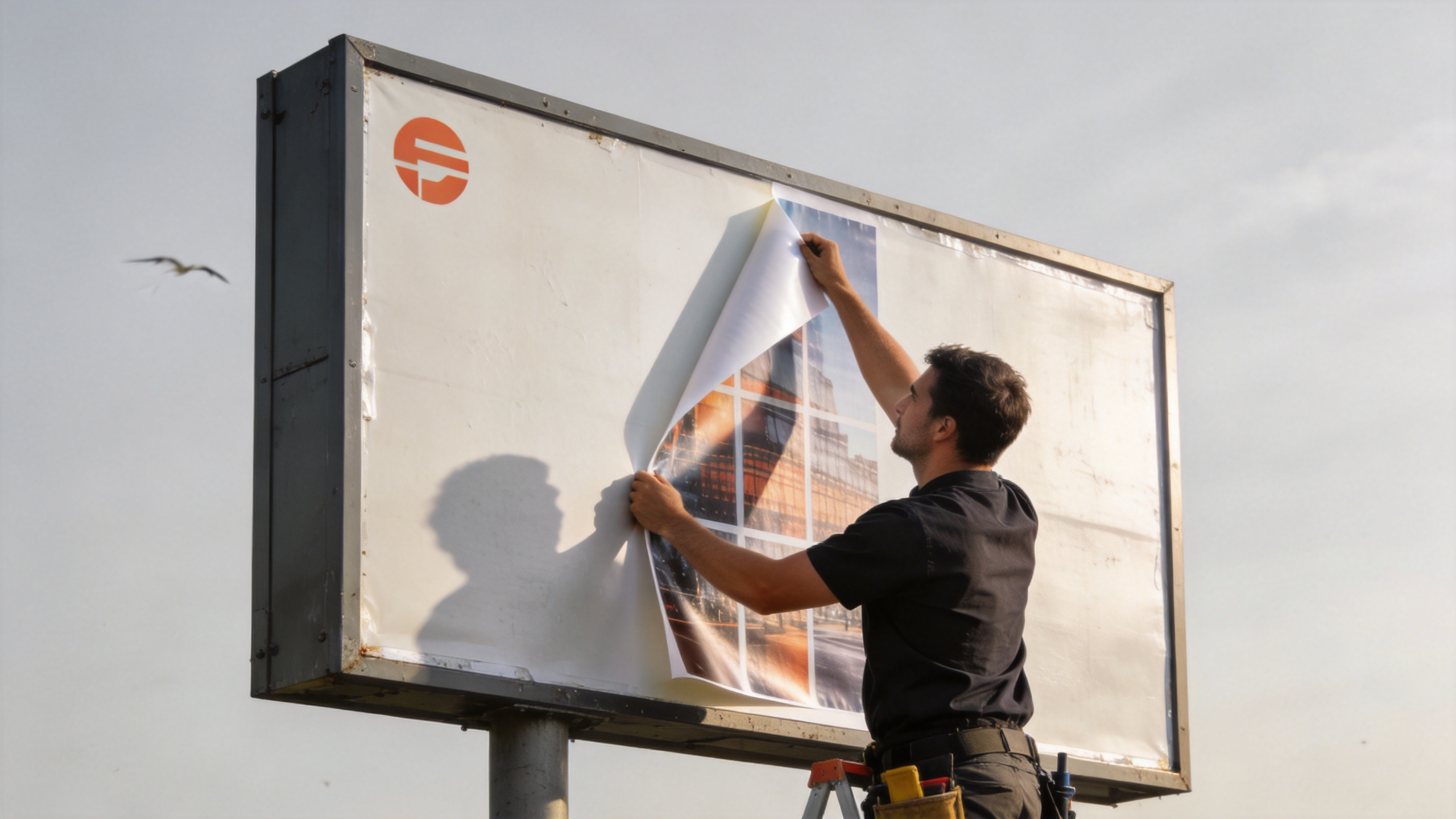
For an outdoor job, enlarge the evaluation plan. Confirm exposure direction, expected installation duration, the use of a protective laminate, and the surface condition. Accelerated weathering evidence can be useful when it is tied to a specific construction and test condition. ISO 4892-2 specifies xenon-arc light exposure with moisture to reproduce weathering effects on plastics; it is a meaningful example of the kind of evidence to request, but it should not be converted into a blanket durability claim for every self-adhesive film installation.
Outdoor performance also depends on factors outside the roll: surface preparation, edge sealing where appropriate, ink cure, application temperature, and installer technique. A technically suitable self-adhesive film can still disappoint if applied to a damp, dusty, poorly bonded, or highly irregular surface.
A practical sampling checklist for production teams
- Document the printer, ink set, profile, print mode, and curing or drying conditions used with the self-adhesive film.
- Apply samples to the real substrate or a verified equivalent after a consistent cleaning process.
- Review print quality, opacity where relevant, edge behavior, repositioning, and bubble release after application.
- For outdoor work, request construction-specific test information and state the exposure conditions of the intended project.
- Evaluate the complete graphic system, including laminate, contour cutting, and installation method.
- Keep approved samples and job notes so repeat orders use the same validated self-adhesive film workflow.
How to build a more dependable supply decision
For wholesalers and larger graphic producers, supply consistency matters alongside the initial sample result. Ask prospective suppliers how they control coated-material production, how they identify lots, and what information accompanies samples. Zhejiang Yueqianshu Digital Technology works in precision coating materials and digital printing media, with an ISO-certified quality-management framework and a green-manufacturing focus described in its company profile. Those capabilities are most useful when paired with a job-specific sampling plan, not treated as a substitute for validating a particular self-adhesive film construction.
The strongest purchase decision therefore connects material, printer, substrate, finish, and installation conditions. Start small, record what happened, then scale a confirmed workflow. That discipline helps a team choose self-adhesive film for indoor displays and outdoor graphics with fewer avoidable reprints and clearer expectations at handover.
 Hot News